
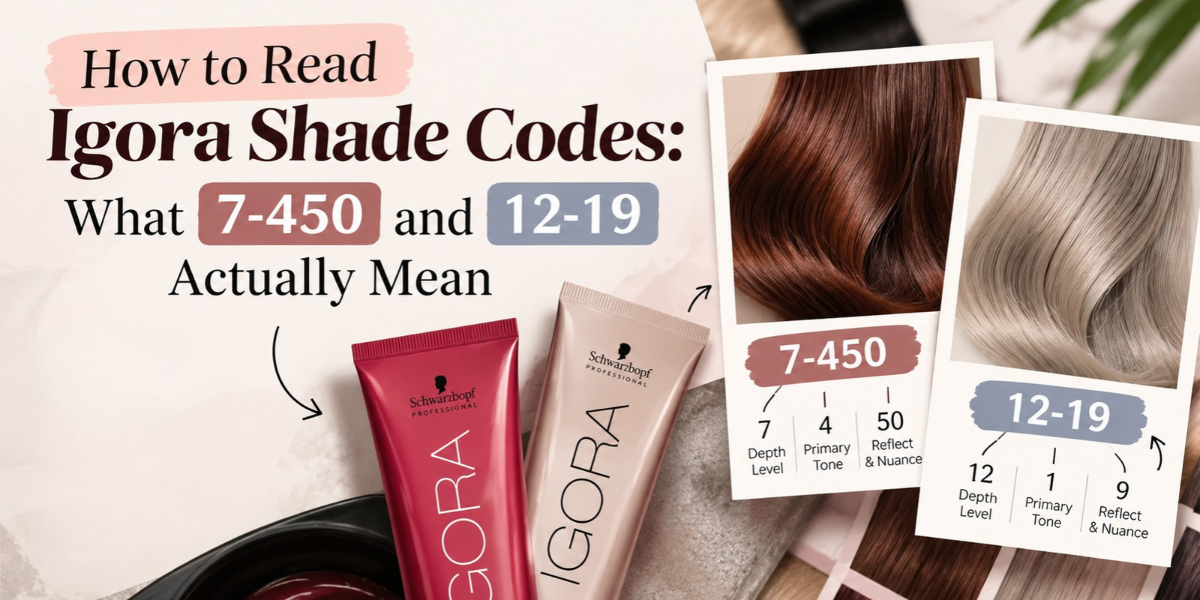
Open any professional hair colour range and you will see rows of shades with names like 7-450 or 12-19. They look like a secret code, and in a way they are one. Once you learn the system, though, choosing a shade stops feeling like guesswork. Take the Igora Royal Absolutes 7-450 Medium Blonde Beige Gold Neutral as an example. Every number in it tells you something.
This guide walks through the logic step by step, so you can read a shade chart with confidence.
The Number Before the Dash: Depth
The first number is the level, which describes how light or dark the shade is. Lower numbers are darker and higher numbers are lighter. Roughly speaking:
- 1 is black and 3 is dark brown
- 5 is light brown and 6 is dark blonde
- 7 is medium blonde and 8 is light blonde
- 9 is extra light blonde and 10 is ultra blonde
- 12 is special blonde, the lightest level in most high-lift lines
So 7-450 starts as a medium blonde. A 12-19 starts as a very, very pale blonde.
The Numbers After the Dash: Tone
After the dash come the tone numbers, which describe the colour direction. The first digit is the primary tone. The second is the secondary tone, which supports the first. If there is a third digit, it adds a further nuance. A common convention in Igora shade charts is:
- 0 is natural
- 1 is cendre, a cool ashy tone, and 2 is ash
- 4 is beige
- 5 is gold
- 6 is chocolate
- 7 is copper
- 8 is red
- 9 is violet
Always confirm against the chart printed on your pack or the manufacturer's chart, as conventions can differ slightly between lines.
Decoding 7-450
Break it down. The 7 is a medium blonde. The 4 is beige, the 5 is gold, and the 0 is natural. That gives a medium blonde with a creamy beige lead, a touch of gold and a natural base. The shade name confirms it: Medium Blonde Beige Gold Neutral. It is a soft, warm-neutral blonde, not an ashy one.
Decoding 12-19
Now the other end of the chart. The 12 means special blonde, the lightest level. The 1 is cendre and the 9 is violet. That gives a very pale blonde with a cool ashy lead and a violet support that cancels yellow. If you look at the Igora Royal Highlifts 12-19 Special Blonde Cendre Violet, the name says it all.
More Examples Worth Knowing
Practice on a few more shades from our range:
- 6-60 is a dark blonde with a chocolate lead and a natural base
- 7-55 is a medium blonde with an extra-strong gold tone
- 7-67 is a medium blonde with chocolate and copper
- 10-49 is an ultra blonde with beige and violet
- 12-2 is a special blonde with ash
Doubled digits such as 55 or 77 usually mean an extra intense version of that tone.
Why the Colour Wheel Helps
Tone selection often follows the same logic as the colour wheel. Opposite colours cancel each other. Violet cancels yellow, blue cancels orange, and green cancels red. That is why 9 shows up so often in blonde shades and why blue-based products are used to tame orange. According to general information on the colour wheel, complementary colours sit opposite each other and neutralise one another when mixed, which is the principle behind toning.
Level Is Not the Same as Result
The number on the tube is the target shade on an ideal base, not a promise of what you will see on your head. Your starting level, any previous colour and the developer you use all change the final result. A 7-450 over very dark hair, for example, will not look like a 7-450 on a natural level 6.
Pick Your Shade Like a Pro
Start with your current level, decide whether you want warm, neutral or cool, and then look for the tone digits that match. If you want to cover grey, a shade with a natural 0 in it tends to give the most dependable coverage. If you want a statement tone, go for one with doubled digits. When in doubt, take a strand test.
Frequently Asked Questions
Is a higher number always lighter? Yes, the first number is the depth level.
Do all brands use the same codes? No, and even within one brand different lines can vary, so check the pack chart.
What does a 0 mean after the dash? It usually indicates a natural tone.
Final Thoughts
Shade codes are a language, and a simple one once you know the grammar. Read the level first, then the tone, and check it against your base. With that, picking colours becomes a decision you can make confidently, whether you colour your own hair or work with clients every day.
Disclaimer
This article is for general informational purposes only. Shade charts can vary between product lines, so always refer to the manufacturer's chart. Hair colour is a chemical product and should be used as directed, ideally by a trained professional. Results are not guaranteed.